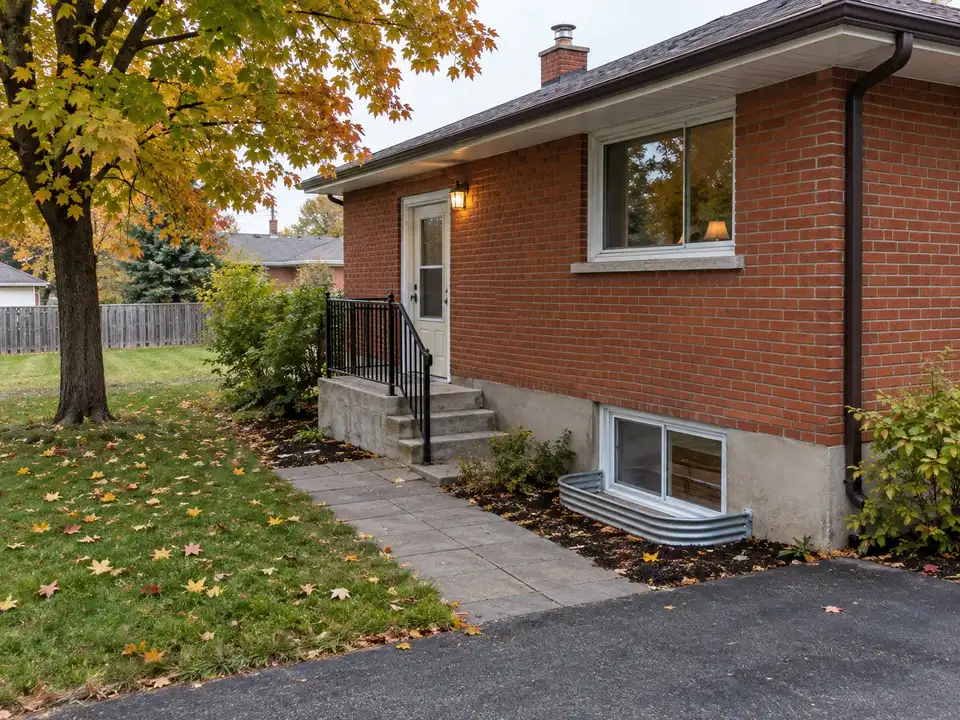
ReverseMortgageOshawa.ca is a reverse mortgage information website for Oshawa homeowners aged 55 and older. This page covers one use of the money: building a legal basement apartment in Oshawa, or a garden suite in the backyard. You might want the unit for a caregiver, for a grown child, or for rent each month.
A legal second unit takes two things: a lot the City allows it on, and money to build it. Both are covered below, with the City’s own numbers.
What Oshawa allows on your lot
Oshawa allows up to three homes on one lot, as long as the main house is a single detached, semi-detached, duplex or street townhouse house in one of the residential zones the zoning by-law lists (City of Oshawa, 2026). That could mean the main house, a basement apartment and a garden suite.
A unit isn’t allowed on hazard lands mapped by the Central Lake Ontario Conservation Authority. It also isn’t allowed where the main house is only permitted for now under a holding symbol in the zoning.
Garden suites have size limits
Only one of the units can be in a separate building in the yard. All the buildings in your yard together can cover no more than the smallest of three limits: 8% of the lot, half of the house’s ground coverage, or 60 square metres (City of Oshawa, 2026).
Parking and the path to the door
Parking comes next. A lot with two homes needs three parking spaces, and a lot with three homes needs four. At least half of the front yard must stay as lawn or garden. The new unit’s outside door also needs a hard path at least 0.81 metres wide, all the way to the street.
Permits, registration and fees
A new unit needs a building permit from the City. After the building inspector’s final inspection, the City sends a two-unit house registration certificate within 60 days (City of Oshawa, 2026).
A unit that already exists has its own rule. If it was created before July 1994, you register it with Municipal Licensing for a $500 fee. If it was created after July 1994, it needs a building permit to make it legal (City of Oshawa, 2026).
The 2026 permit fees are set per square metre. Finishing a basement in a house costs $7.79 per square metre, with a minimum area of 50 square metres. A building in the yard for people to live in costs $15.56 per square metre. The smallest permit fee is $160 (City of Oshawa, Building By-law, 2026).
For example, an 80 square metre basement apartment would carry a permit fee of about $623 (80 times $7.79). A 60 square metre garden suite would be about $934 (60 times $15.56). These are the City’s fees only; the building work is a separate cost.
How a reverse mortgage pays for the unit
When every owner on the title is at least 55, a reverse mortgage lets you borrow against the house. With no required monthly mortgage payments, no new bill leaves your bank account while the unit goes up. Property tax, insurance and upkeep are still paid by you.
Rent isn’t part of qualifying
There’s no bank-style income test. The lender checks your income only far enough to see that your property taxes are comfortably affordable. You don’t have to show a lease or a tenant to qualify.
Borrowed money isn’t income, so the reverse mortgage money is tax-free and leaves Old Age Security and the Guaranteed Income Supplement alone. Rent is different: that rule covers the loan, not the rent.
For example: a detached house
Say the youngest owner is 70 and the house is worth Oshawa’s September 2026 detached benchmark of $750,700 (TRREB, September 2026). At 70, the most you could get is up to 52.85% of the home’s value, or about $396,700.
The amount isn’t extra money on top of your current mortgage. If $90,000 is still owing, that’s paid off first from the same money, leaving about $306,700 ($396,700 minus $90,000). The appraisal sets the real figure. You can check your own numbers with the Oshawa reverse mortgage calculator.
You can take a lump sum at closing to pay the builder, or a smaller amount now and more later at lenders that allow it. Interest is charged only on money you actually take.
What a unit could rent for in Oshawa
The most recent official rent figures cover purpose-built rental apartments, not basement units. In October 2025, the average rent for those apartments in the City of Oshawa was $1,724 a month, and a two-bedroom averaged $1,771 (CMHC, Rental Market Survey, October 2025). The vacancy rate was 4.1%, up from 3.6% a year earlier.
If your home is in the area around Durham College and Ontario Tech University and you rent to tenants, the City requires a residential rental licence. For a house, the fees are a $50 application fee plus $275 and $75 per bedroom, for a licence that lasts two years (City of Oshawa, 2026).
The federal tax credit for a family unit
The Multigenerational Home Renovation Tax Credit is a refundable federal credit. It applies to up to $50,000 of eligible costs to build a self-contained second unit, so a person 65 or older, or an adult with a disability, can live with a relative (Canada Revenue Agency).
This credit fits a unit for family, not a unit rented to a stranger. Ask your accountant how it applies to your plan.
No City or Durham grant for second units
Neither the City of Oshawa nor Durham Region offers a grant for second units. The City’s incentive programs are for commercial and downtown properties (City of Oshawa). The money comes from your own savings, a loan, or your home.
Other ways to pay, and who decides
A HELOC (home equity line of credit) or a refinance can also pay for a second unit. Both come with an income test and monthly payments. Richard Hopkins, Mortgage Broker, sets those next to what the four reverse mortgage lenders offer. You get a recommendation based on your situation, even if it’s not a reverse mortgage.
When the unit is meant for a caregiver, the page on paying for home care in Oshawa explains the public and private help. If you’d rather help a child buy a place of their own, see helping your child buy in Oshawa. Before you build, the Oshawa home prices guide shows what homes in each part of the city sold for, and the Oshawa property tax guide covers the bill that stays yours to pay. If you’d rather change the main house so it’s easier to live in, see accessible home renovations in Oshawa.
Richard's part in it
- Estimates what your Oshawa home could provide before you collect contractor quotes
- Runs your building plan past all four Canadian lenders
- Emails which lender gives the best deal for the project
- Shows what you still owe coming off first, so the building money is clear
- Explains taking one lump sum or part now and part later
- Includes your son or daughter on every email, if you'd like
- Checks a HELOC or refinance too, and recommends what suits you
- Keeps track of the appraisal and each step to closing
Comparing your options
| Question | Reverse mortgage | HELOC (home equity line of credit) | Your savings |
|---|---|---|---|
| Monthly payments | No required mortgage payments | Required, and they rise when prime rises | None |
| Income test | No bank-style income test | Yes, including a stress test | None |
| Age rule | Every owner on title 55 or older | No age rule | None |
| Interest | Compounds twice a year, added to the loan | Variable rate tied to prime | None owed, but spent money stops earning |
| Money not used yet | Interest only on money you take | Interest only on what you draw | Stays in your account |
Oshawa guides that go deeper
- Oshawa House Prices in 2026, and What Your Home Could Give You
- Oshawa Property Tax for Seniors: Rates, Due Dates and Relief Programs
- What Does Downsizing in Oshawa Cost?
Sources
Figures checked October 16, 2026.
- City of Oshawa, Accessory Apartments (zoning, garden suites, parking)
- City of Oshawa, Two-Unit Houses (registration)
- City of Oshawa, Building By-law, Schedule B permit fees (effective January 1, 2026)
- City of Oshawa, Incentives and Programs
- City of Oshawa, Residential Rental Housing licensing
- Canada Revenue Agency, Multigenerational Home Renovation Tax Credit
- CMHC, Rental Market Survey data tables, Oshawa, October 2025
- TRREB, Market Watch, September 2026